
A delightful retrospective of Israeli Jewish New Year cards

The tradition of giving hard-copy Rosh Hashana cards has nearly disappeared but these charmingly kitschy greetings are enjoying a second life online.
A black and white photos where people, including children, gather around a street stall displaying postcards. A sign in Hebrew is visible on the stall. The scene appears to be in a busy outdoor market or street.
Israelis crowd around a temporary sidewalk tabletop stand in 1955 to purchase greeting cards for the Jewish New Year. Photo courtesy of the Government Press Office

For decades, one of the loveliest of Jewish New Year traditions in modern Israel was sidewalk greeting-card sellers. The cards they displayed for the holiday – often with crudely drawn graphics or out-of-date photographs and encrusted with glitter – had their own special charm.

Sadly, in the age of instant messaging, e-mail and social networks, these greeting-card popup shops have all but disappeared during the High Holidays in Israel.

The origin of the modern-day Shana Tova postcard is as old as the modern-day post office, according to a National Library of Israel essay.

“Around the time that the postal service emerged, in the 1880s, Jewish entrepreneurs were beginning to print commercial greeting cards for the new year. By this time, new year greetings constituted the main body of postcards sent by Jews, and this would remain so for some 100 years.”

With the advent of the Zionist movement, new motifs began to appear on Rosh Hashana greetings cards. Even the Messiah himself could be photo-montaged into an actual landscape of the Land of Israel.
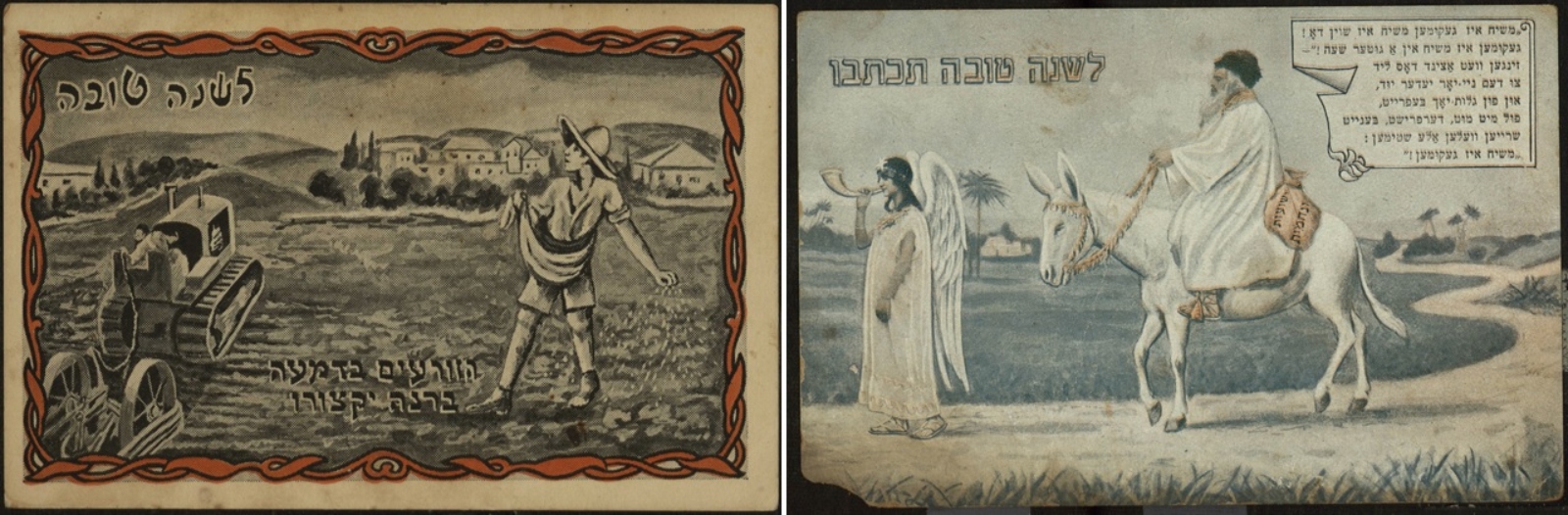
A split image shows two vintage greeting cards. On the left is card with an illustration of a farmer plowing a field near a village; on the right is an illustration of a man who rides a donkey while speaking to another standing man. Both cards feature Hebrew text with New Year's greetings.
At left, a New Year’s greeting with the biblical phrase “They who sow in tears shall reap in joy.” At right is a Yiddish New Year’s greeting depicting the arrival of the Messiah on a white donkey. Credit: National Library of the State of Israel

Zionist leaders, agricultural settlement, and new cities like Tel Aviv all figured in the postcards sent from pre-State Palestine to friends and relations.
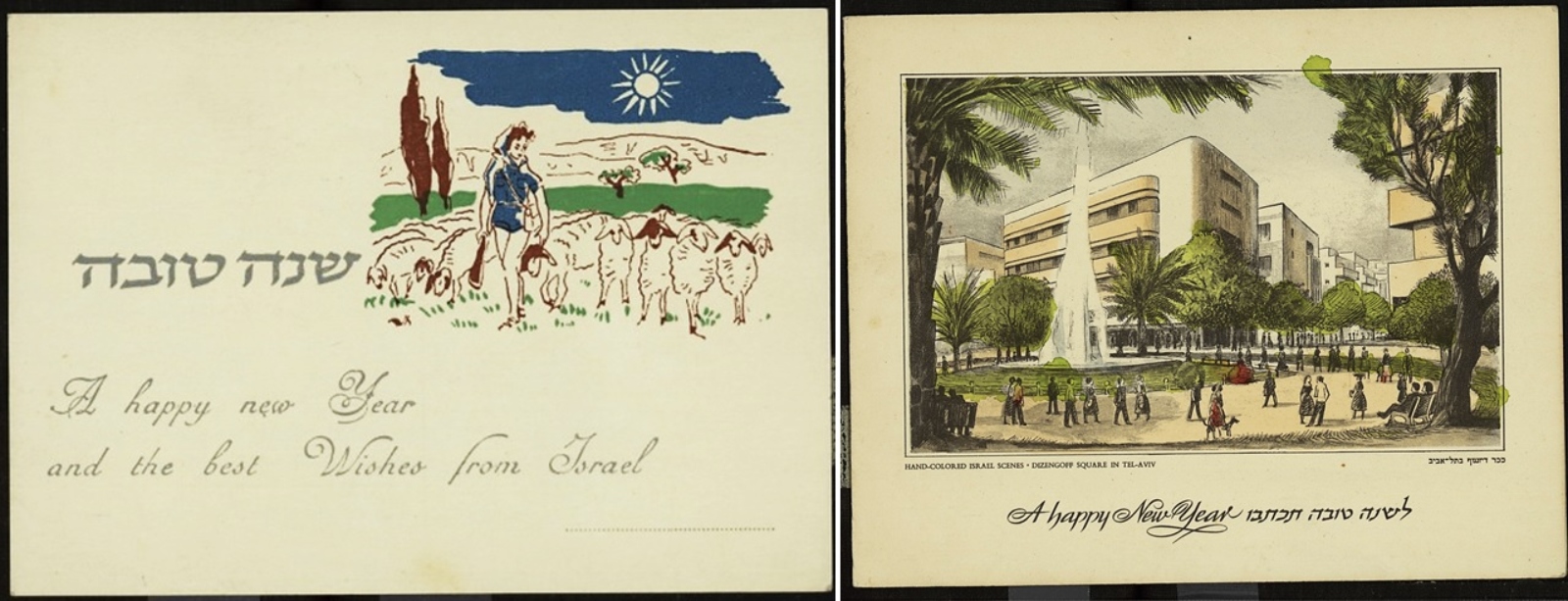
Split image: Left side shows a New Year’s card with a shepherd, sheep, and an Israeli flag, with Hebrew and English Rosh Hashana greetings. Right side shows a greeting card with a vintage illustration of a university building with palm trees and people.
At left, a postcard depicting a pioneer shepherdess in shorts and a blue workers shirt. At right, the modern city of 1930s Tel Aviv. Credit: National Library of the State of Israel

The Jewish New Year is traditionally a time for community donations, and cards played an important part in fund-raising for organizations. The National Library essay notes, “The cards played an important role in fundraising for [Jewish] community purposes… Secular nationalist organizations such as the Jewish National Fund, Keren Hayesod (the Jewish Agency) and the Joint Distribution Committee followed suit.”

Two vintage Jewish New Year cards: one with a smiling child holding a branch and illustrated pomegranates, the other with a black-and-white landscape photo, wheat, grapes, and Hebrew text.
At left, grapes carried aloft by pioneers are emblazoned with symbols of the new State of Israel. At right, Kibbutz Mashabei Sadeh and the JNF-KKL celebrate the greening of the Negev region with an image of a new irrigation pipe. Credit: National Library of the State of Israel

Family life was a symbol of success in the new land. Those who could afford such luxuries might print up personalized new year’s greetings featuring a family portrait.
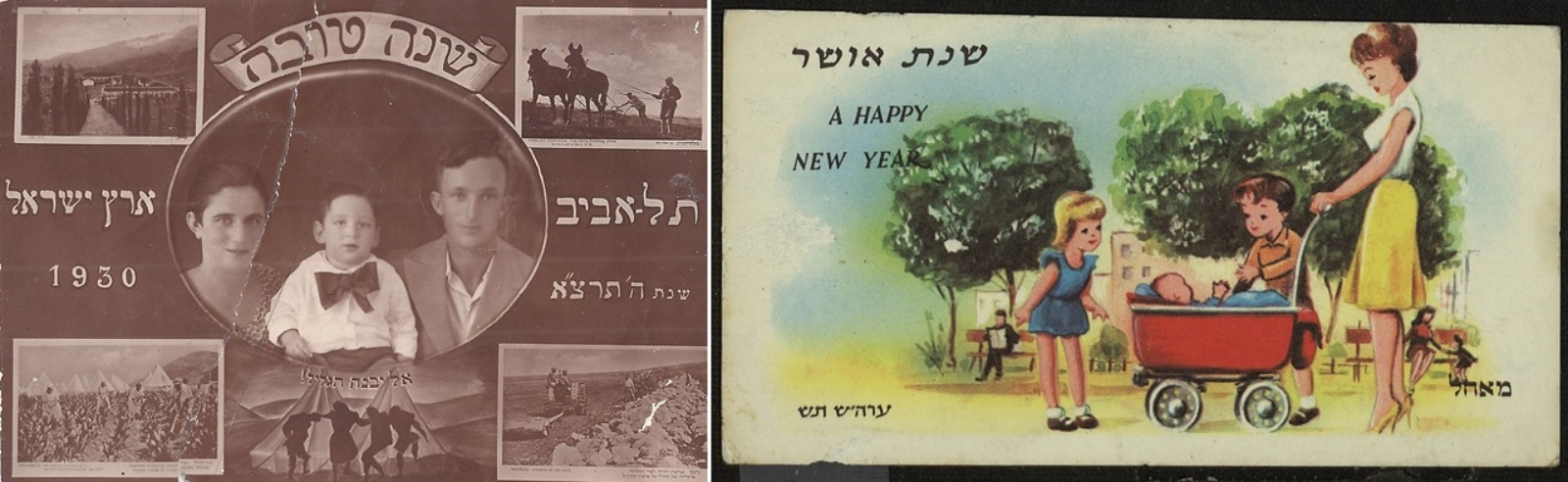
At left, a 1930s greeting card from Tel Aviv with a family photo and images of pre-State Israel. At right, a family-oriented greeting card from the 1940s. Credit: National Library of the State of Israel

With the establishment of the Israel Defense Forces during the War of Independence, the image of the Jewish soldier as a symbol of national renewal also figured prominently. This motif became ever-more popular after the Six-Day War.
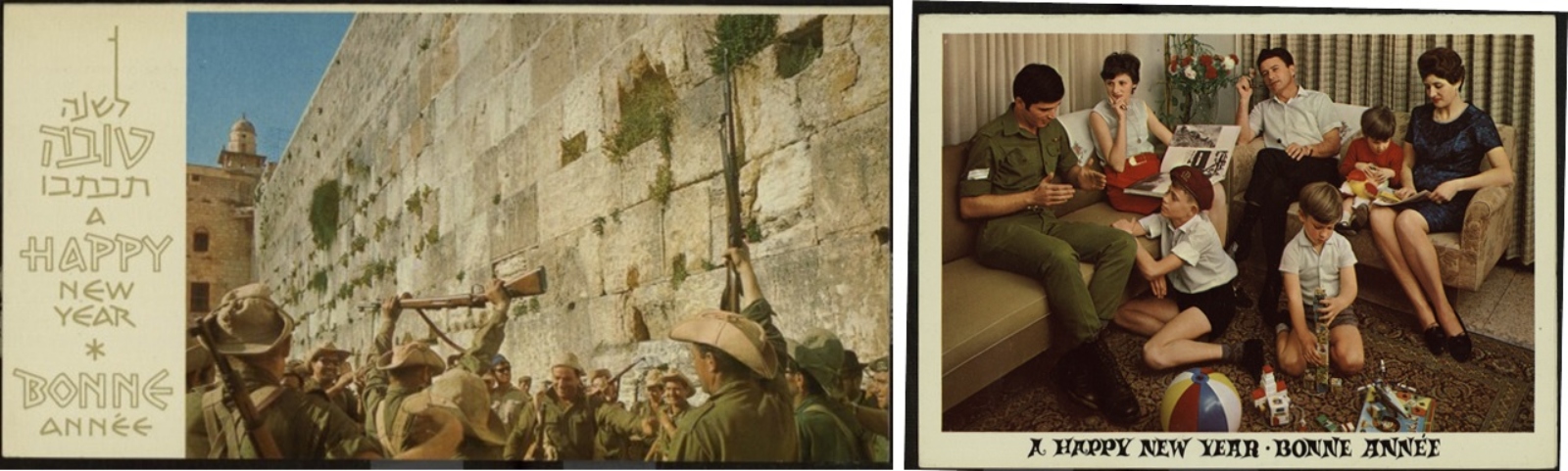
On the left, a greeting card features soldiers gathered and touching the Western Wall. On the right, a greeting card features a photo of a family sitting together in a living room with children and toys. Both images have “Happy New Year” written in Hebrew, English, and French.
At left, a card celebrating Israel’s victory in June 1967 war. At right, a card featuring the popular motifs of family and IDF soldiers. Credit: National Library of the State of Israel

As the Israeli economy grew, cards depicted more material wishes for prosperity in the coming year: new cars, new houses and other riches.
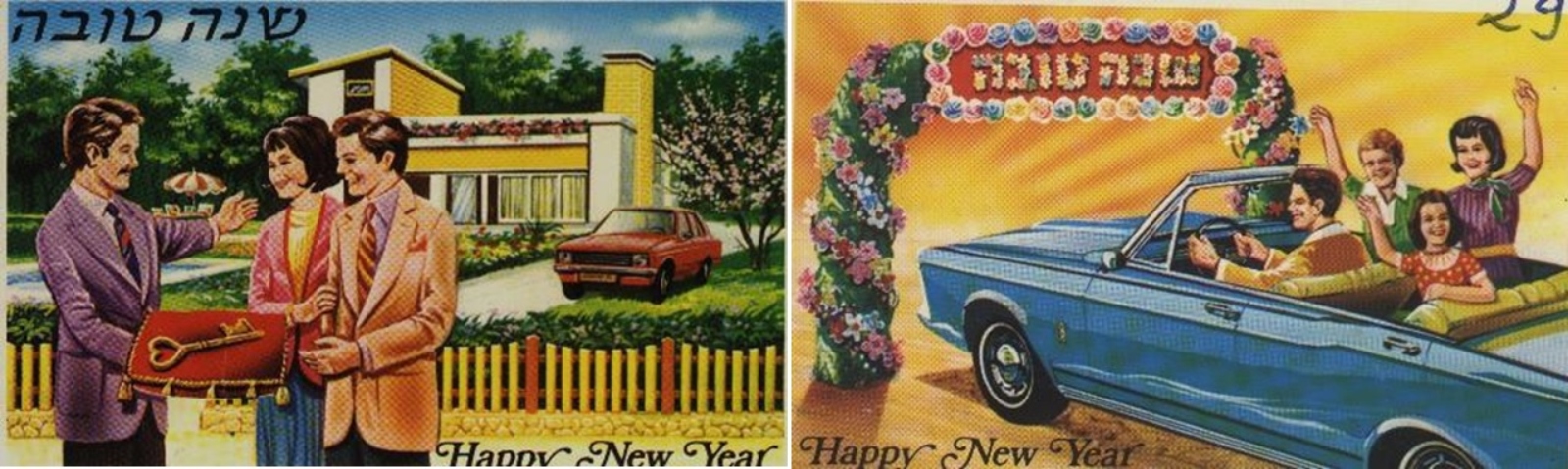
Two vintage New Year cards: one shows a couple receiving a large key to a new house, the other shows a joyful family waving while riding in a blue convertible under a Happy New Year banner. Both have the words "Happy New Year" written in Hebrew and in English.
These kitschy Israeli Rosh Hashana greeting cards are enjoying a second life through the holiday card-sharing service offered by Nostalgia Online.

Today, Israelis are more likely to send one another their New Year’s greetings via WhatsApp. For those with New Years nostalgia, fortunately, there are websites that allow online users with a nostalgic bent to share images from days gone by. These include the National Library of Israel, which also offers educational programming materials; a holiday card-sharing service offered by the wonderful Nostalgia Online; the Museum of the Jewish People at Beit Hatfutsot; and Wikipedia in Hebrew, which has an extensive collection of holiday greeting card images.