

Dating apps are now the most popular way to meet new people — but they’re fundamentally flawed, says Guy Zidkia.
They keep users swiping right (that’s a “yes please” on Tinder, the market leader) but they don’t address the need for a deeper connection or a lasting relationship.
Their priority is for subscribers to stay and pay, says Zidkia, founder and CEO of Mylo.
This Israeli dating app takes a different approach. It uses AI to match users based on their interests and their responses to carefully curated questions – rather than their looks.
Mylo guides the initial conversation with a series of questions (examples below), gradually bringing blurred pictures of both sides into sharper focus, helping two strangers overcome awkwardness as they meet (virtually) for the first time.
The program not only aims to help users find a meaningful relationship with someone who shares their vibe, but it also acts as a confidante who checks in (privately) with both parties to see how things are going.
Getting to know me
I tried out Mylo – despite being happily married – just to get a flavor, though I stopped short of making any real-life connections.
Mylo’s first question out of five for me was: “Do you prefer to plan everything in advance, or are you more of a spontaneity and improvisation kind of person?” with four options to choose.
Next questions: “Do you make decisions more based on logic and emotion?” and “Are you a relatively quiet person or someone who makes a big entrance when they walk into a room?”
Mylo then told me it had found some users with great matching potential. I deleted the app after receiving this message: “I want to ensure that both of you have the same vibe, so I will get back to you as soon as they are available.”

Some other examples of Mylo questions:
- Are you a dog person or a cat person?
- What talent would you like to have?
- How do you wake up in the morning?
- Which reality show would you participate in?
- What makes a day a good day?
- Which podcast interests you more?
- Your ideal treat is?
- Do you believe in God?
- How do you feel about nature?
- Do you like sleeping cuddled up?
- What kind of friend are you?
- Friendship in two words
- What personality trait attracts you the most?
- Your secret to a good relationship
- In a relationship, what small thing makes you smile?
- The perfect romantic vacation?
Finding matches quickly
Mylo (from the words “my” and “love”) isn’t the first dating app to use AI. But other apps use it to retain subscribers. Mylo uses it to make connections.

The app launched six months ago in Israel and will soon have 100,000 domestic users seeking same-sex as well as heterosexual partners, Zidkia tells ISRAEL21c. It caters for different religions, and within Judaism it recognizes different levels of observance.
The aim is to expand the service, with language and culture adjustments, to other countries.
One measure of its success so far is that users find matches quickly.
“On Tinder or other dating apps, a male need to see 80 to 100 profiles to get one match. On Mylo it’s typically 10. So it’s much less frustration, much less rejection,” says Zidkia.
Another measure of success, ironically, is that users are quick to delete the app. Zidkia contacted dozens of ex-Mylo users to see why they’d canceled.
“We thought maybe they’d randomly checked a box to say they’d found love,” he said, “but I needed to check so I texted, then I called, and I found out it was true.
“These are couples who believe it’s a long-term relationship; they no longer need a dating app. And when I called them, in most cases, they were together. It was couples at that early stage, when they spend lots of time together.
“Most of them told me they’d spent many years on dating apps without seeing results or had given up of the idea of dating apps.
“They heard we were different, and downloaded the app, still skeptical that AI could do something for them, but were surprised to find it was super-quick, just two weeks in some cases.”
Applying math to matchmaking
Zidkia says the goal is for Mylo to charge a one-time fee until users find a match, but for the time being a subscription to the end of 2025 costs 300 shekels ($82), which he describes as “the most competitive offer in the industry.”
The global online dating market is huge — set to generate $10 billion of revenue this year – and growing.
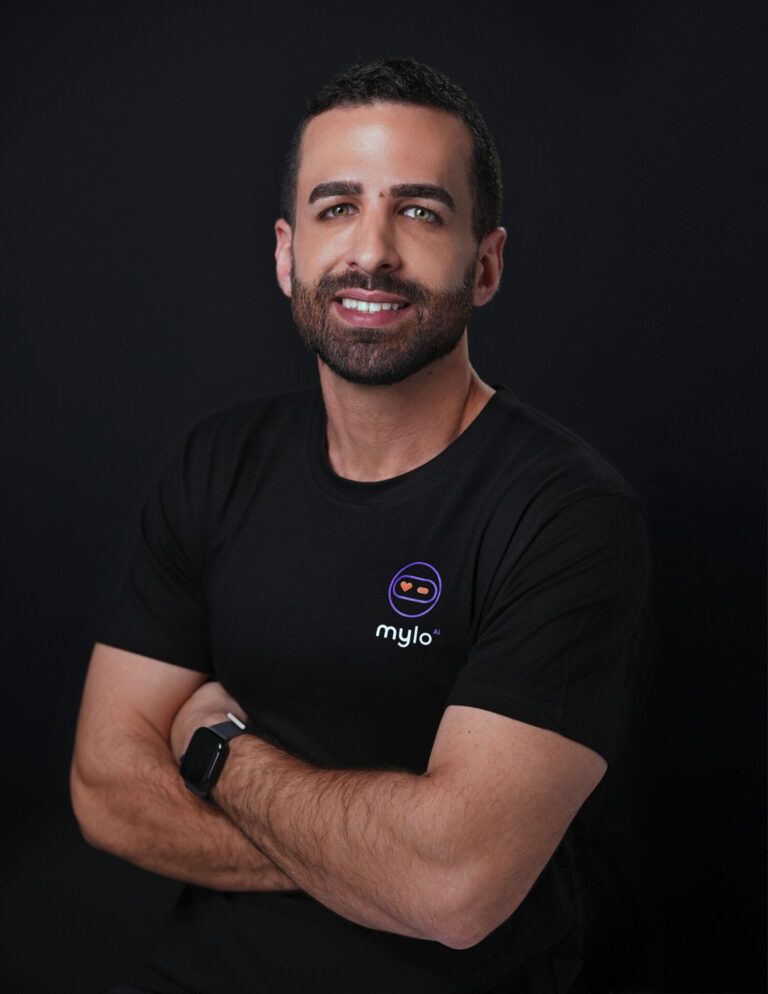
But Zidkia saw room for improvement when examining thousands of dating apps.
His background is in math. He was fast-tracked onto a university program when he was just 13, started trading stocks and bonds when he was 16, and went on to graduate with a BA in economics, followed by an MBA.
He first encountered AI in financial markets and then in the gaming industry, but soon became convinced he could put it to better use: dating.
“I saw how AI and machine learning can be developed in different applications,” he said. “How people can use the same algorithms for capital market, for gaming, for listening to music on YouTube or Spotify, for ordering Uber or ordering food. It’s basically the same algorithms with different mechanics.
“I saw that dating apps are broken. Sixty percent of relationships start online, but people rate the apps with the lowest score in any industry.”
And so, in 2022, he started developing Mylo in collaboration with more than 100 freelancers, each with their own unique perspective.
“The goal is basically to reshape the way people find love and to make it faster for them, to get to a place where the business model is about the results and not about the time people spend on the app,” says Zidkia. “We want people to spend less time on the app.”
When I ask Zidkia about his own romantic status, he declines to get into specifics, “but I would say I’m single and I like the way it is right now.”
The Tel Aviv-based Mylo is self-funded, but Zidkia is now working toward launching a Series A round of venture capital financing.
For more information, click here.